Friday, November 8, 2019

Alcibiades a Greek Absalom


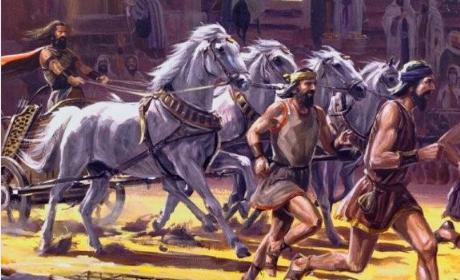
Absalom's Chariot 
by
 
Damien F. Mackey


“The picture of Absalom that is presented in 2 Samuel 13–19 suggests that
he was the Alcibiades of the Old Testament, alike in his personal attractiveness,
his lawless insolence, and his tragic fate”.
 
Britannica.com


There is that knee-jerk reaction, again, that the Hebrew must be based upon the pagan Greek.
Absalom was not “the Alcibiades of the Old Testament”.
Absalom was a fully fleshed-out historical son of King David, and the Greeks later, in their typical fashion, appropriated Absalom as their fictitious character, “Alcibiades” (or Alkibiades).
 
Many parallels could be drawn between Absalom and Alcibiades, and some have been.
For instance:
 
 
Rosalyn Rossignol writes, in “Critical Companion to Chaucer: A Literary Reference to His Life and Work” (p. 319): “Like the biblical ABSALOM … Alcibiades became legendary for his beauty, and two of Chaucer’s references to him are attributable to that”.
 
And:
https://en.wikisource.org/wiki/Page:Syria,_the_land_of_Lebanon_(1914).djvu/80
“The value of team-work is a comparatively new idea to western Asia and eastern Europe. Since the days of Alcibiades and Absalom the old ideal has been that of "every man for himself." If it had not been so, the history of the world might have been different”.
 
And:
http://www.nyu.edu/library/bobst/collections/exhibits/bobst/washsq/voices/volumes/cdreeme/html/CD_020.HTM
 
"What! Densdeth, the cleverest man I have ever met?"
 
"The same."
 
"Densdeth, handsome as Alcibiades, or perhaps I should say Absalom, as he is Hebrewish ?"
 
"That very Alcibiades, Absalom, Densdeth."


And:
https://cdn.dal.ca/content/dam/dalhousie/pdf/fass/Classics/Hankey/Behold%20thy%20Mother%20Requiem%20for%20Petronella%20Neish.pdf
 
The stories of the great lovers prick our hearts and illumine our minds: Ruth and Naomi, David and Absalom, Jonathan and David, Achilles and Patroclus, Socrates and Alcibiades, Jesus and John.
 
Ruth said to Naomi, “Entreat me not to leave thee, or to return from following after thee: for whither thou goest, I will go; and where thou lodgest, I will lodge: thy people shall be my people, and thy God my God: Where thou diest, will I die, and there will I be buried: the LORD do so to me, and more also, if ought but death part thee and me.” ….
Socrates declared to Alcibiades: “I am the only friend who has never left you because I was the only lover of you, the rest were lovers only of what was yours.... [I am sent by God to bring you to self-knowledge]. If your soul, my dear Alcibiades, is to know herself, she must see ... her highest part, the spring of her virtue [mirrored in another] ... [There she will see what of herself] resembles God. Whoever looks at this, and comes to know all that is divine, will gain thereby the best knowledge of himself. ….
Achilles wept: “My dear friend has perished, Patroclus, whom I loved beyond all my companions, as well as my own life...and now I must die soon because I was not there to stand beside my friend when he was killed.” ….
David was much moved, and went up to the chamber over the gate, and wept: and as he went, thus he said, “O my son Absalom, my son, my son Absalom! would God I had died for thee, O Absalom, my son, my son!” ….
Jesus said: “This is my commandment, That ye love one another, as I have loved you. Greater love hath no man than this, that a man lay down his life for his friends. Ye are my friends.” ….

Thursday, November 7, 2019

Hatshepsut’s progression from Israel, Beersheba, to woman-ruler of Egypt


by

 
Damien F. Mackey


“Do you really think that Hatshepsut was Solomon's wife?
I don't think so. Hatshepsut ruled alone for many years”.

(A reader)


Introduction
 
The following sequence (i-v) is basically how I see the extraordinary progression of the career of Hatshepsut Maatkare, from
 
(i)                 a princess in King David’s realm, beginning in the king’s old age, through vicissitudes and desolation, and rebellion in the kingdom of Israel, to become
(ii)              the Queen of Beersheba, appointed there by her maternal ‘grandfather’, Tolmai of (southern) Geshur (“Gezer”), who would succeed Amenhotep I as ruler of Egypt and Ethiopia, as Thutmose I, to her
(iii)            visit and marriage to King Solomon in Jerusalem at the height of his wisdom and power, to her
(iv)             subsequent marriage in Egypt to Thutmose II, whom she would succeed as
(v)               woman-ruler of Egypt and Ethiopia alongside her ‘nephew’ Thutmose III.    
 
Point (v) is perfectly in accordance with the testimony of Flavius Josephus that the Queen of Sheba who visited King Solomon was ‘the Queen of Egypt and Ethiopia’ (Ant. 8:165–173).
Since Sheba is not Egypt (though an attempt has been made to equate it with Thebes in Egypt), our heroine must have experienced the rulership of at least two separate countries.
Furthermore, Hatshepsut’s throne name, Maatkare (“Maat (the goddess of truth) is the life force of Re”), or Makera, closely resembles Makeda, the name of the biblical queen according to Ethiopian legend (Kebra Nagast).
 
 
Point (i) above encompasses her life as Abishag, the beautiful young virginal princess who served as the ageing King David’s nursemaid, and, some say, his consort-wife.
The name “Abishag” (or “Abishaug”) is, according to some views, “unknown”, and may be a Hebrew attempt to transliterate the foreign name, Hatshepsut, which Sir Alan Gardiner had rendered, “Hashepsowe” (Abishaug?).
Her Hebrew name was Tamar. She, the ‘sister’ of prince Absalom, being the unfortunate beautiful young virginal princess (again) in the care of King David, who was raped by her half-brother, Amnon, David’s oldest son.
This situation left her desolate, and forced her to live in the home of Absalom (in Shunem?) where she, unlike her fellow princesses, became “black” from working out in the sun (Song of Solomon).
The young Solomon, to whom David must have promised her, “the Shunammite”, was constantly on the lookout for her.
 
Point (ii) above encompasses her life when her brother, Absalom, who eventually killed Amnon, had to flee Jerusalem. He sought asylum with his maternal grandfather, Tolmai, king of southern Geshur, near Beersheba. Their mother’s name was Maacah, which name is uncannily similar to Hatshepsut’s throne name, Maa(t)kare, less the theophoric (re): hence Maacah = Maa[t]ka-  
Though we are not told that Tamar fled with Absalom, it would be expected, given her complete subjection to her brother as a young woman shamed (and now with a child?).
And presumably she would have returned with Absalom to Jerusalem after King David had pardoned his son. For we find her, as Abishag, serving David during the revolt of another oldest son, Adonijah, towards the end of David’s life.
 
 
Solomon, the rightful heir to the throne of Jerusalem, will eventually slay Adonijah, who had presumed to ask for the hand of Abishag - a request which was tantamount to asking for the throne.
Such was the prestige of the young woman by now.
 
King Tolmai had now succeeded Amenhotep I to the throne of Egypt and he, now Thutmose I, apparently had great plans for his so-called “daughter”, Hatshepsut – though Thutmose I never actually names her as his daughter. He was the biblical “pharaoh” who will give King Solomon’s future wife the chief city of Geshur (= “Gezer”), which is Beersheba, as a dowry.
 
Jesus Christ gives the clearest geographical indications about the Queen of the South, at “the ends of the earth”, in other words, the south end (frontier) of the land (of Israel), the northern end being Dan (we frequently read of the full length of the land of Israel, “from Dan to Beersheba”).
In the Book of Joshua, Beersheba is called, simply, “Sheba”.
 
Point (iii) above includes when the Queen of the South was biding her time in the capital city (Beersheba) of the Negev desert region whilst her fiancée, Solomon, was busy building Jerusalem and the Temple of Yahweh. She could hardly wait to see what Solomon had been up to, and she was overwhelmed when she arrived in Jerusalem and saw the city/Temple in all of its magnificence.
King Solomon will set up a palatial residence for his queen whom he has married - she, his childhood friend, being his very favourite queen.
 
Point (iv) When Thutmose I dies, the couple undergo a diplomatic divorce (“she returned”) in order for her, as Hatshepsut, to marry Thutmose II, and so weld together the kingdoms of Egypt and Israel.
Egypt had become highly important to King Solomon as a trading partner.
 
It is at this point that the biblical scribes seem to lose interest in King Solomon, the mercantile king, whose trade with Egypt, and his many foreign wives, had begun to lead him into apostasy.
 
Point (v) above encompasses the famous queen’s virtual rulership of Egypt while Thutmose III (son of one of Thutmose II’s concubines) was still very young.
Before long she will put aside all pretence and declare herself as the first ruler of the land, duly (though bizarrely) adding a manly beard to her statues.
King Solomon will enter the land at her request and will greatly assist her as Senenmut (Senmut), her multi-tasking Steward, her quasi-royal consort, and her (you name it) – Senenmut being, according to some “the real power behind the throne”.    
 
Eventually Solomon dies, and then, not long afterwards, Hatshepsut.
The long-suffering Thutmose III becomes free to burst upon the scene as “The Napoleon of Egypt” (Breasted).
 

Friday, October 18, 2019

Hatshepsut - Warrior Monarch


“… Hatchepsut is portrayed as a sphinx, a human-headed crouching lion

crushing the traditional enemies of Egypt”.


...

[Hatshepsut's] temple [at Deir el Bahri] was filled with many beautiful scenes that prove herself as Pharaoh. There was even some reference to military activity at the temple, even though she is often portrayed as a peaceful queen. She did, in fact, have some conquest, like the rest of her seemingly war-loving family.


This refers to a campaign in Nubia. She even sent Thuthmose III out with the army, on various campaigns (many of which little is known at all!). One inscription even says that Hatshepsut herself led one of her Nubian campaigns. The inscription at Sehel island suggest that Ty, the treasurer of Lower Egypt, went into battle under Hatshepsut herself. This proves her as a warrior Pharaoh to her people, and also depicts her expedition to the Land of Punt. ....


Moreover, we read at:


In 'Hatchepsut, the Female Pharaoh', Joyce Tyldesley writes:


'Evidence is now growing to suggest that Hatchepsut's military prowess has been seriously underestimated due to the selective nature of the archaeological evidence which has been compounded by preconcieved notions of feminine pacifism.


Egyptologists have assu[m]ed that Hatchepsut did not fight, and have become blind to the evidence that, in fact, she did. As so many of Hatchepsut's texts were defaced, amended or erased after her death, it is entirely possible that her war record is incomplete. Furthermore, Hatchepsut's reign, falling between the reigns of two of the greatest generals Egypt was ever to know (Tuthmosis I and Tuthmosis III) is bound to suffer in any immediate comparison.


The Deir el-Bahri mortuatry temple provides us with evidence for defensive military activity during Hatchepsut's reign. By the late 19th century Naville had uncovered enough references to battles to convince him that Hatchepsut had embarked on the now customary series of campaigns against her vassals to the south and east. These subjects, the traditional enemies of Egypt, almost invariably viewed any change of [pharaoh] … as an opportunity to rebel against their overlords, while the [pharaohs] … themselves seem to have almost welcomed these minor insurrection as a means of proving their military might.


The fragments and inscriptions found in the course of the excavations at Deir el-Bahri show that during Hatchepsut's reign wars were waged against the Ethiopians, and probably also against the Asiatics. Among these wars which the queen considered the most glorious, and which she desired to be recorded on the walls of the temple erected as a monument to her high deeds, was the campaign against the nations of the Upper Nile.


Blocks [originally] … sited on the eastern colonnade show the Nubian god Dedwen leading a series of captive southern towns towards the victorious Hatchepsut, each town being represented by a name written in a crenellated cartouche and topped by an obviously African head. The towns all belong to the land of Cush (Nubia). Elsewhere in the temple, Hatchepsut is portrayed as a sphinx, a human-headed crouching lion crushing the traditional enemies of Egypt. There is also a written, but unfortunately badly damaged, description of a Nubian campaign in which Hatchepsut appears to be claiming to have emulated the deeds of her revered father;


.....as was done by her victorious father, the King of Upper and Lower Egypt, Aakheperkare (Tuthmosis I) who seized all lands....a slaughter was made among them, the number of dead being unknown, their hands were] … cut off....she overthrew (gap in text) the gods (gap in text)...


….

Hatchepsut's military policy is perhaps best described as one of unobtrusive control; active defence rather than deliberate offence … while either unwilling or unable to actually expand Egypt's sphere of influence in the near east, she was certainly prepared to fight to maintain the borders of her country. '


Source(s): 'Hatchepsut The Female Pharaoh' by Joyce Tyldesley

King David’s troublesome sons


 SonsOfDavid.jpg

by

 
Damien F. Mackey


“King David was a national hero in the history of Israel. The author of
the Books of 1, 2  Kings could have made King David look better by embellishing
David’s life and hiding dirty secrets of David’s family life.
For some reason, however, the writer revealed ugly truths about King David’s dysfunctional family”.
 
Rev. Jerry Cho
 
 
When David was young, he, filled with a holy zeal, feared no man, not even the giant Goliath, nor did he fear lion or bear (I Samuel 17:32-37):
 
David said to Saul, ‘Let no one lose heart on account of this Philistine; your servant will go and fight him’.
Saul replied, ‘You are not able to go out against this Philistine and fight him; you are only a young man, and he has been a warrior from his youth’.
But David said to Saul, ‘Your servant has been keeping his father’s sheep. When a lion or a bear came and carried off a sheep from the flock, I went after it, struck it and rescued the sheep from its mouth. When it turned on me, I seized it by its hair, struck it and killed it. Your servant has killed both the lion and the bear; this uncircumcised Philistine will be like one of them, because he has defied the armies of the living God. The Lord who rescued me from the paw of the lion and the paw of the bear will rescue me from the hand of this Philistine’.
 
Nothing was too hard for him!
But as he grew older, more famous, and rather more comfortable, he would complain about his sister Zeruiah’s formidable sons, Joab and Abishai (2 Samuel 3:39): ‘... I am this day weak, though anointed king; and these men the sons of Zeruiah be too hard for me: the LORD shall reward the doer of evil according to his wickedness’.
 
It was not only his military officers, though, who were causing King David many headaches.
His sons, too, towards whom he tended to be grossly over-indulgent, would prove extremely troublesome for him.
Rev. Jerry Cho tells of some of it when writing about King David’s dysfunctional family:
 
Text: 2 Samuel 18:5-9, 15, 31-33
Title: David and Absalom
Preacher: Rev. Jerry Cho
Date: Aug. 16, 2009
 
When I visited Boston a few weeks ago, I saw of a statue of Samuel Adams, one of the founding fathers of the United States. In the statue Samuel Adams was lean and tall. But our tour guide said that Samuel Adams was short and plump in real life. The sculptor made Samuel Adams look better because he was a national hero.
 
King David was a national hero in the history of Israel. The author of the Books of 1, 2 Kings could have made King David look better by embellishing David’s life and hiding dirty secrets of David’s family life.
 
For some reason, however, the writer revealed ugly truths about King David’s dysfunctional family. For example, King David had an affair with a married woman. He had her husband killed. King David’s baby son from the woman died at infancy. King David had another son, named Amnon. Amnon raped Tamar, King David’s daughter. Namely, Amnon raped his half sister. Tamar’s brother, Absalom, was infuriated at Amnon, his half brother. So Absalom killed Amnon and ran away.
 
A few years later, King David decided to forgive Absalom, thinking, “Amnon is dead. There is nothing I can do about it. Even though Absalom did things to hurt me, he is still my son. I want to forgive him and make up with him.”
 
Absalom came home and made peace with his father. But the reconciliation and peace was short lived. A conflict, a much more serious conflict between King David and Absalom arose because Absalom realized that he was not going to be the heir of King David. Absalom decided that he would.
 
So Absalom gathered up his followers and tried to kill his father so that he might be a king.
As there were many followers of Absalom, King David had to run for his life. The Bible records that King David walked barefoot escaping from Absalom and crying over the tragic domestic situation.
 
At first Absalom’s army was winning the battle over David’s army. But later the table was turned. David’s army defeated Absalom’s army and was chasing Absalom. King David told his Generals to treat Absalom gently.
 
Absalom was fleeing for his life on horseback. David’s army was gaining on him when Absalom’s long hair was caught by the tree branches. His horse kept running without him. Absalom was dangling in midair and David’s soldiers found him and killed him.
Upon hearing the news, King David became very sad and said to himself, “Absalom, Absalom, my son, it would have been better if I had died instead of you.”
 
Talk about a dysfunctional family. King David had about everything ugly in his family such as incest, rape, domestic violence, rebellion, and intentional homicide among family members. ....

[End of quote]
 
And the reverend Cho has not even gone on to mention Adonijah’s rebellion after Absalom’s, or, later (after David’s death), the apostasy of Solomon with his many foreign wives.


Thursday, October 17, 2019

So-called “Minoans” were the Philistines


Philistines Flee

by
 
Damien F. Mackey


Those whom Sir Arthur Evans fancifully named ‘the Minoans’,
based on the popular legend of King Minos, son of Zeus,
are biblically and historically attested as the Philistines.  


Gavin Menzies has followed Arthur Evans in labelling as “Minoans” the great sea-faring and trading nation that is the very focal point of his fascinating book, The Lost Empire of Atlantis: History's Greatest Mystery Revealed (HarperCollins, 2011). Though the ex-submariner, Menzies, can sometimes ‘go a bit overboard’ - or, should I say, he can become a bit ‘airborne’ (and don’t we all?) - he is often highly informative and is always eminently readable.
According to the brief summary of the book that we find at Menzies’ own site: http://www.gavinmenzies.net/lost-empire-atlantis/the-book/
 
 
... the Minoans. It’s long been known that this extraordinary civilisation, with its great palaces and sea ports based in Crete and nearby Thera (now called Santorini), had a level of sophistication that belied its place in the Bronze Age world but never before has the extent of its reach been uncovered.
 
Through painstaking research, including recent DNA evidence, Menzies has pieced together an incredible picture of a cultured people who traded with India and Mesopotamia, Africa and Western Europe, including Britain and Ireland, and even sailed to North America.
 
Menzies reveals that copper found at Minoan sites can only have come from Lake Superior, and that it was copper, combined with tin from Cornwall and elsewhere, to make bronze, that gave the Minoans their wealth. He uses knowledge gleaned as a naval captain to explore ancient shipbuilding and navigation techniques and explain how the Minoans were able to travel so far. He looks at why the Minoan empire, which was 1500 years ahead of China and Greece in terms of science, architecture, art and language, disappeared so abruptly and what led to her destruction. ...
 
[End of quote]
 
The Philistines
 
Thanks to Dr. Donovan Courville (The Exodus Problem and its Ramifications, Loma Linda CA, 1971), we can trace the Philistines - through their distinctive pottery - all the way back to Neolithic Knossos (Crete). And this, despite J. C. Greenfield’s assertion: “There is no evidence for a Philistine occupation of Crete, nor do the facts about the Philistines, known from archaeological and literary sources, betray any relationship between them and Crete” (IDB, 1962, vol. 1, p. 534). The distinctive type of pottery that Courville has identified as belonging to the biblical Philistines is well described in this quote that he has taken from Kathleen Kenyon:
 
The pottery does in fact provide very useful evidence about culture. The first interesting point is the wealth of a particular class of painted pottery …. The decoration is bichrome, nearly always red and black, and the most typical vessels have a combination of metopes enclosing a bird or a fish with geometric decoration such as a “Union Jack” pattern or a Catherine wheel. At Megiddo the first bichrome pottery is attributed to Stratum X, but all the published material comes from tombs intrusive into this level. It is in fact characteristic of Stratum IX. Similar pottery is found in great profusion in southern Palestine … Very similar vessels are also found on the east coast of Cyprus and on the coastal Syrian sites as far north as Ras Shamra. [Emphasis Courville’s]
 
By contrast, the pottery of the ‘Sea Peoples’ - a maritime confederation confusingly identified sometimes as the early biblical Philistines, their pottery like, but not identical to the distinctive Philistine pottery as described above - was Aegean (Late Helladic), not Cretan.  
 
The indispensable “Table of Nations” (Genesis 10), informs us that the Philistines were a Hamitic people, descendants of Ham’s “son”, Mizraim (or Egypt) (v. 6).
Genesis 10:13: “Mizraim was the father of the Ludites, Anamites, Lehabites, Naphtuhites, Pathrusites, Kasluhites (from whom the Philistines came) and Caphtorites”.
These earliest Philistines would be represented by the users of this distinctive pottery at Neolithic I level Knossos (Dr. Courville):
 
With the evidences thus far noted before us, we are now in a position to examine the archaeological reports from Crete for evidences of the early occupation of this site by the Caphtorim (who are either identical to the Philistines of later Scripture or are closely related to them culturally). We now have at least an approximate idea of the nature of the culture for which we are looking ….
 
… we can hardly be wrong in recognizing the earliest occupants of Crete as the people who represented the beginnings of the people later known in Scripture as the Philistines, by virtue of the stated origin of the Philistines in Crete. This concept holds regardless of the name that may be applied to this early era by scholars.
The only site at which Cretan archaeology has been examined for its earliest occupants is at the site of the palace at Knossos. At this site deep test pits were dug into the earlier occupation levels. If there is any archaeological evidence available from Crete for its earliest period, it should then be found from the archaeology of these test pits. The pottery found there is described by Dr. Furness, who is cited by Hutchinson.
 
“Dr. Furness divides the early Neolithic I fabrics into (a) coarse unburnished ware and (b) fine burnished ware, only differing from the former in that the pot walls are thinner, the clay better mixed, and the burnish more carefully executed. The surface colour is usually black, but examples also occur of red, buff or yellow, sometimes brilliant red or orange, and sometimes highly variegated sherds”.
 
A relation was observed between the decoration of some of this pottery from early Neolithic I in Crete with that at the site of Alalakh ….
 
Continuing to cite Dr. Furness, Hutchinson commented:
 
Dr. Furness justly observes that “as the pottery of the late Neolithic phases seems to have developed at Knossos without a break, it is to the earliest that one must look for evidence of origin of foreign connections”, and she therefore stresses the importance of a small group with plastic decoration that seems mainly confined to the Early Neolithic I levels, consisting of rows of pellets immediately under the rim (paralleled on burnished pottery of Chalcolithic [predynastic] date from Gullucek in the Alaca [Alalakh] district of Asia Minor). [Emphasis Courville’s]
 
While the Archaeological Ages of early Crete cannot with certainty be correlated with the corresponding eras on the mainland, it would seem that Chalcolithic on the mainland is later than Early Neolithic in Crete; hence any influence of one culture on the other is more probably an influence of early Cretan culture on that of the mainland. This is in agreement with Scripture to the effect that the Philistines migrated from Crete to what is now the mainland at some point prior to the time of Abraham.[[1]]
[End of quotes]
 
Late Chalcolithic, we have already learned, pertains to the era of Abram (Abraham), when the Philistines were apparently in southern Canaan:
 
Better archaeological model for Abraham
 
 
We next find the Philistines in the land of Palestine (the Gaza region) at the time of Joshua. Was there a Philistine migration out of Crete (“Caphtor”) at the time of the Exodus migration out of Egypt? (Amos 9:7): “Did I not bring Israel up from Egypt, the Philistines from Caphtor and the Arameans from Kir?”
Dr. John Bimson becomes interesting at this point, as previously I have written:
 
Here I take up Bimson’s account of this biblical tradition:[2]
 
There is a tradition preserved in Joshua 13:2-3 and Judges 3:3 that the Philistines were established in Canaan by the end of the Conquest, and that the Israelites had been unable to oust them from the coastal plain …. There is also an indication that the main Philistine influx had not occurred very much prior to the Conquest. As we shall see below, the Philistines are the people referred to as “the Caphtorim, who came from Caphtor” in Deuteronomy 2:23 … where it is said that a people called the Avvim originally occupied the region around Gaza, and that the Caphtorim “destroyed them and settled in their stead”. Josh. 13:2-3 mentions Philistines and Avvim together as peoples whom the Israelites had failed to dislodge from southern Canaan. This suggests that the Philistines had not completely replaced the Avvim by the end of Joshua’s life. I would suggest, in fact, that the war referred to in Ex. 13:17, which was apparently taking place in “the land of the Philistines” at the time of the Exodus, was the war of the Avvim against the newly arrived Philistines.
 
As conventionally viewed, the end of MB II C coincides with the expulsion of the Hyksos from Egypt. Bimson however, in his efforts to provide a revised stratigraphy for the revision of history, has synchronised MB II C instead with the start of Hyksos rule. He will argue here in some detail that the building and refortifying of cities at this time was the work of the Avvim against the invading Philistines, with some of the new settlements, however, likely having been built by the Philistines themselves.
 
[End of quote]
 
I have further written on Dr. Bimson’s laudable effort to bring some archaeological sanity to this era:
 
Bimson has grappled with trying to distinguish between what might have been archaeological evidence for the Philistines and evidence for the Hyksos, though in actual fact it may be fruitless to try to discern a clear distinction in this case. Thus he writes:[3] 
 
Finds at Tell el-Ajjul, in the Philistine plain, about 5 miles SW of Gaza, present a particularly interesting situation. As I have shown elsewhere, the “Palace I” city (City III) at Tell el-Ajjul was destroyed at the end of the MBA, the following phase of occupation (City II) belonging to LB I …. There is some uncertainty as to exactly when bichrome ware first appeared at Tell el-Ajjul.
Fragments have been found in the courtyard area of Palace I, but some writers suggest that this area remained in use into the period of Palace II, and that the bichrome ware should therefore be regarded as intrusive in the Palace I level ….
It seems feasible to suggest that the invading Philistines were responsible for the destruction of City III, though it is also possible that its destruction was the work of Amalekites occupying the Negeb (where we find them settled a short while after the Exodus; cf. Num. 13:29); in view of Velikovsky’s identification of the biblical Amalekites with the Hyksos … the Amalekite occupation of the Negeb could plausibly be dated, like the Hyksos invasion of Egypt, to roughly the time of the Exodus …. But if our arguments have been correct thus far, the evidence of the bichrome ware favours the Philistines as the newcomers to the site, and as the builders of City II.
[End of quotes]
 
Next we come to the Philistines in the era of King Saul, for a proper appreciation of which I return to Dr. Courville’s thesis. He, initially contrasting the Aegean ware with that of the distinctive Philistine type, has written:
 
The new pottery found at Askelon [Ashkelon] at the opening of Iron I, and correlated with the invasion of the Sea Peoples, was identified as of Aegean origin. A similar, but not identical, pottery has been found in the territory north of Palestine belonging to the much earlier era of late Middle Bronze. By popular views, this is prior to the Israelite occupation of Palestine. By the altered chronology, this is the period of the late judges and the era of Saul.
… That the similar pottery of late Middle Bronze, occurring both in the north and in the south, is related to the culture found only in the south at the later date is apparent from the descriptions of the two cultures. Of this earlier culture, which should be dated to the time of Saul, Miss Kenyon commented:
 
The pottery does in fact provide very useful evidence about culture. The first interesting point is the wealth of a particular class of painted pottery …. The decoration is bichrome, nearly always red and black, and the most typical vessels have a combination of metopes enclosing a bird or a fish with geometric decoration such as a “Union Jack” pattern or a Catherine wheel. At Megiddo the first bichrome pottery is attributed to Stratum X, but all the published material comes from tombs intrusive into this level. It is in fact characteristic of Stratum IX. Similar pottery is found in great profusion in southern Palestine … Very similar vessels are also found on the east coast of Cyprus and on the coastal Syrian sites as far north as Ras Shamra. [Emphasis Courville’s]
 
Drawings of typical examples of this pottery show the same stylized bird with back-turned head that characterized the pottery centuries later at Askelon.
… The anachronisms and anomalies in the current views on the interpretation of this invasion and its effects on Palestine are replaced by a consistent picture, and one that is in agreement with the background provided by Scripture for the later era in the very late [sic] 8th century B.C.
[End of quotes]


[1] It is interesting in light of this that Dr. J. Osgood has synchronized Chalcolithic En-geddi with the era of Abraham. ‘Times of Abraham’, p. 181.
[2] ‘The Arrival of the Philistines’, p. 13.
[3] ‘The Arrival of the Philistines’, pp. 14-15.