Friday, September 1, 2017

Joseph and Tamar Comparisons


Image result for potiphar's wife and joseph

by

 Damien F. Mackey


A parent’s favourite, given a special cloak, sold out by brothers, mocked, sexually harrassed, emerging from the desert on a spices-laden camel train, imprisoned, though much admired, capable of good management, ruling in Egypt as second only to Pharaoh.
These are just some of the similarities that Tamar at the time of King David shared with Joseph.


This article presupposes my multi-identifications of Tamar as developed in:

The vicissitudinous life of Solomon's pulchritudinous wife


“Conclusion 2: Abishag, of uncertain name, the same as Tamar (her given Hebrew name), hailing from Shunem, was hence “the Shunammite” of King Solomon’s Song of Songs. Ethnically, she may have been Egypto-Canaanite, which thought will lead to the consideration … that she was also Velikovsky’s Hatshepsut = “Queen of Sheba”.”


Some of the Comparisons

Joseph, beloved of his father (Genesis 37:3): “Now Israel [Jacob] loved Joseph more than any of his other sons …”, was hated by his brothers (v. 4): “ When his brothers saw that their father loved him more than any of them, they hated him and could not speak a kind word to him”.

The “Shunammite” was (Song of Solomon 6:9): “… the favourite of her mother, perfect to the one who gave her birth”, but mis-treated by her brothers (1:6): “My mother’s sons [brothers] were angry with me and made me take care of the vineyards”.

Joseph’s father “made an ornate robe for him” (Genesis 37:3).

Tamar “was wearing an ornate robe, for this was the kind of garment the virgin daughters of the king wore” (2 Samuel 13:18).

The exact same Hebrew words to describe “ornate robe”, or “coat of many colours”, are used in the case of Joseph and of Tamar, ketonet passim (כְּתֹנֶת פַּסִּים).

Jacob sent Joseph to his brothers (Genesis 37:13): ‘As you know, your brothers are grazing the flocks near Shechem. Come, I am going to send you to them’.
‘Very well’, he replied.

David sent Tamar to her ‘brother’, Amnon (2 Samuel 13:7, 8): “David sent word to Tamar at the palace: ‘Go to the house of your brother Amnon and prepare some food for him’.
So Tamar went …”.

From “Hebron ….” (Genesis 37:14).

Six of Tamar’s ‘brothers’ were born to David at “Hebron” (I Chronicles 3:1-4).

Joseph asks a man at Shechem (Genesis 37:16): ‘I’m looking for my brothers. Can you tell me where they are grazing their flocks?’

Similarly the Shunammite asks her beloved (Song of Solomon 1:7): ‘Tell me, you whom I love, where you graze your flock and where you rest your sheep at midday’.

Joseph’s brothers “plotted to kill him” (Genesis 37:18).

Tamar was a pawn in a conspiratorial plot by Absalom and his adviser to kill Amnon (see above article).

“So when Joseph came to his brothers, they stripped him of his robe—the ornate robe he was wearing” (Genesis 37:23).

“Tamar … tore the ornate robe she was wearing” (2 Samuel 13:19).

Joseph’s brothers “looked up and saw a caravan of Ishmaelites coming from Gilead” (Genesis 37:25).

Were they “flock of goats”-like?
(Song of Solomon 4:1): ‘Your hair is like a flock of goats descending from the hills of Gilead”.

“Their camels were loaded with spices, balm and myrrh, and they were on their way to take them down to Egypt” (Genesis 37:25).

(I Kings 10:1, 2): “… the Queen of Sheba … came … to … Jerusalem with a very great caravan—with camels carrying spices …”.

“Judah said to his brothers, ‘… after all, he is our brother’.” (2 Genesis 37:26, 27).

“Her brother Absalom said to [Tamar], ‘…. Be quiet for now, my sister; he is your brother’.” (2 Samuel 13:20).

“… his brothers pulled Joseph up out of the cistern and sold him for twenty shekels of silver” (Genesis 37:28).

“Solomon had a vineyard in Baal Hamon; he let out his vineyard to tenants. Each was to bring for its fruit a thousand shekels of silver” (Song of Solomon 8:11).

“… the Ishmaelites … took [Joseph] to Egypt” (Genesis 37:28).

‘I liken you, my darling, to a mare among Pharaoh’s chariot horses’ (Song of Solomon 1:9).

“Reuben returned to the cistern and saw that Joseph was not there, he tore his clothes. He went back to his brothers and said, ‘…. Where can I turn now?’ (Genesis 37:29, 30).

‘What about me? Where could I get rid of my disgrace? And what about you? You would be like one of the wicked fools in Israel’ (2 Samuel 13:13).

“Then Jacob tore his clothes, put on sackcloth and mourned for his son many days. All his sons and daughters came to comfort him …” (Genesis 37:34-35).

“The king stood up, tore his clothes and lay down on the ground; and all his attendants stood by with their clothes torn” (2 Samuel 13:31).

Given the above similarities, it would be no accident that the narrative concerning Joseph is suddenly interrupted by Genesis 38, the account of Judah and another “Tamar” who is treated with some disrespect by Joseph’s brother, Judah.

“Joseph found favour in his eyes and became his personal attendant. Potiphar put him in charge of his household, and he entrusted to his care everything he owned” (Genesis 39:4).

“Abishag … took care of the king and waited on him …” (I Kings 1:4).
“And Achitophel said to Absalom. ‘Go in unto thy father’s concubines, which he hath left to keep the palace …’ (2 Samuel 16:21).

“Now Joseph was well-built and handsome …” (Genesis 39:6).

“… Tamar, the beautiful sister of Absalom son of David” (2 Samuel 13:1).
“… they searched throughout Israel for a beautiful young woman and found Abishag, a Shunammite” (I Kings 1:3).
‘O thou fairest among women …’ (Song of Solomon 1:8).
“… Hatshepsut still described herself as a beautiful woman, often as the most beautiful of women …” (https://en.wikipedia.org/wiki/Hatshepsut).

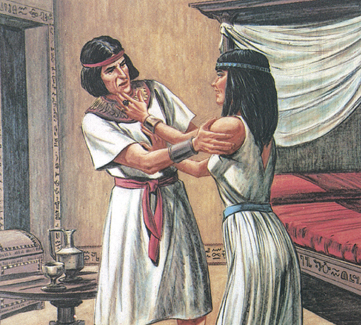
“… after a while his master’s wife took notice of Joseph and said, ‘Come to bed with me!’” (Genesis 39:7).

“In the course of time, Amnon … grabbed her and said, ‘Come to bed with me’ …” (2 Samuel 13:1, 11).

{So Judah with the other Tamar ‘Come now, let me sleep with you’ (Genesis 38:16), before his having to concede: ‘She is more righteous than I …’ (v. 26) – something Amnon would fail to do in the case of the other Tamar}.

“But he refused. ‘…. My master has withheld nothing from me except you, because you are his wife. How then could I do such a wicked thing and sin against God?’” (Genesis 39:8, 9).

‘No, my brother!’ she said to him. ‘Don’t force me! Such a thing should not be done in Israel! Don’t do this wicked thing’ (2 Samuel 13:12).

‘When he heard me scream for help, he left his cloak beside me and ran out of the house’ (Genesis 39:15).

“Tamar put ashes on her head and tore the ornate robe she was wearing. She put her hands on her head and went away, weeping aloud as she went” (2 Samuel 13:19).

“When his master heard the story his wife told him … he was furious” (Genesis 39:19).

“When King David heard all this, he was furious” (2 Samuel 13:21).

“Joseph’s master took him and put him in prison, the place where the king’s prisoners were confined’ (Genesis 39:20).

“[Amnon] called his personal servant and said, ‘Get this woman out of my sight and bolt the door after her’.” (Genesis 39:17).
“And Tamar lived in her brother Absalom’s house, a desolate woman” (39:20).

“When two full years had passed …” (Genesis 41:1).

“Two years later …” (2 Samuel 13:23).

Sunday, August 13, 2017

The “Shunammite”


Art by Henry Clive - Cleopatra - Board "Art - All Egypt Cleopatra" -


by
Damien F. Mackey
  
 
“I am black, but comely, O ye daughters of Jerusalem,
as the tents of Kedar, as the curtains of Solomon”.
 Song of Solomon 1:5
 
 
I have multi-identified her as:
 
Abishag: “… a beautiful young woman … a Shunammite” (I Kings 1:3).
Tamar: “Now David’s son Absalom had a beautiful sister named Tamar” (2 Samuel 13:1).
Shunammite: “… fairest among women” (Song of Solomon 1:8).
Queen of Sheba: “King Solomon gave the queen of Sheba all she desired and asked for …” (I Kings 10:13).
Pharaoh’s Daughter: “Solomon made an alliance with Pharaoh king of Egypt and married his daughter” (I Kings 3:1).
Hatshepsut: Whose name means “foremost of noble women”.
 
This can make for some really tricky geography and ethnicity, however.
How can she be, at once, a girl from Shunem in northern Israel; a Queen of exotic Sheba; and an Egyptian royal?
And now we read in Song of Solomon 1:5 that she may have been “black”.
But, whilst that appears to be the literal meaning of the Hebrew word here: shechorah  שְׁחוֹרָה
the reason for her shade of colour, according to the text, was from her working under the sun http://biblehub.com/commentaries/songs/1-6.htm:
 
“The word translated looked upon occurs only twice besides (Job 20:9; Job 28:7). The “all-seeing sun” is a commonplace of poetry; but here with sense of scorching. The heroine goes on to explain the cause of her exposure to the sun. Her dark complexion is accidental, and cannot therefore be used as an argument that she was an Egyptian princess, whose nuptials with Solomon are celebrated in the poem”.
 
Little wonder that, in light of all this, Solomon will ask: ‘Who is she …?’ (Song of Solomon 6:10).
 
Here is my tentative reconstruction of her life:
 
Our “she” began as a beautiful foreign captive girl, daughter of Maacah (Maakah), possibly an Egyptian (Maat-ka-re), who had become the property, maid-servant, of King Talmai of Geshur, whose capital was the important Beer Sheba (Tell Masos).
King David acquired Maacah perhaps during his raids on the “Geshurites” (I Samuel 27:8) – or he may have made a treaty with King Talmai – and subsequently Maacah, now David’s wife, would give birth to Absalom at Hebron (I Chronicles 3:2).
Now, Absalom had a “beautiful sister” called Tamar, according to 2 Samuel 13:1, though some Jewish tradition suggests that Tamar was not Absalom’s actual sister, but, perhaps, a captive girl. She may possibly have been “black”, or, at least, “dark” – an Egyptian, Nubian (or Ethiopian)?
She is contrasted with the (presumably fairer skinned) “daughters of Jerusalem”.
Hebrew-named in 2 Samuel as “Tamar” (“date palm”), the name she is given in I Kings is “Abishag”, an awkward name, that may be a Hebraïsed version of Hatshepsut (which has many variations). She lived in the house of Absalom, which I have suggested was situated at Shunem, in the approximate vicinity of Baal-hamon where Solomon had a vineyard (Song of Solomon 8:11).
Joab had a field adjoining Absalom’s (2 Samuel 14:30).
Her close associations with the royal throne occurred when she was selected to be the nurse-consort of King David after a search had been made “throughout Israel for a beautiful young woman” (I Kings 1:3). This search would have been confined only to noble women.
They “found Abishag, a Shunammite, and brought her to the king. The woman was very beautiful; she took care of the king and waited on him, but the king had no sexual relations with her”.
We next meet her in 2 Samuel 13 as the beautiful virgin Tamar, for whom, dwelling “at the palace”, King David will send (v. 7) in response to his oldest son Amnon’s lovesick request.
Thereupon she is raped by Amnon, treated coldly by her ‘brother’, Absalom – who may actually have conspired with the shrewd adviser, Jonadab (= Achitophel), to bring about this tragic situation. She dwelt a desolate woman in the house of Absalom, now back in Shunem.
Her appalling treatment, which even King David may have condoned by his apparent silence, could have been exacerbated by the fact that she was originally a captive girl, or daughter of one, and perhaps also because of her dark complexion.
When Absalom had murdered Amnon, and fled to the kingdom of Geshur, to his maternal ‘grand-father’, King Talmai, he may have dragged Tamar there with him.
She would later become the queen of Geshur, dwelling at the capital, Beersheba (or Sheba).
Whether she was in Beersheba during Absalom’s revolt, or still at Shunem, or had been re-instated with King David “at the palace”, we do not know.
But she was ministering to King David afterwards, when Adonijah made a play for the throne.
 
One speculative writer is adamant that Abishag was actually the wife-concubine of King David (“Bible Evidence That David Married 12 Year Old Abishag”):
https://discover-the-truth.com/2016/09/25/bible-evidence-that-david-married-12-year-old-abishag/
 
“After the demise of King David, Solomon took over his father’s place and became the King. Adonijah attempted to seize power once more, this time, went around and asked Solomon’s mother to take Abishag as his wife. Adonijah asked her to tell Solomon if he would give him the green light to go ahead and marry Abishag.
Solomon got furious and seen the scheme of Adonijah. In ancient times, to marry one of your father’s wives was seen as you claiming the Throne i.e., become the King. Solomon seeing this, executed his brother, Adonijah:
“The Death of David
10 David died and was buried in David’s City. 11 He had been king of Israel for forty years, ruling seven years in Hebron and thirty-three years in Jerusalem. 12 Solomon succeeded his father David as king, and his royal power was firmly established.
The Death of Adonijah
13 Then Adonijah, whose mother was Haggith, went to Bathsheba, who was Solomon’s mother. “Is this a friendly visit?” she asked. “It is,” he answered,
14 and then he added, “I have something to ask of you.” “What is it?” she asked.
15 He answered, “You know that I should have become king and that everyone in Israel expected it. But it happened differently, and my brother became king because it was the Lord’s will.
16 And now I have one request to make; please do not refuse me.” “What is it?” Bathsheba asked.
17 He answered, “PLEASE ASK KING SOLOMON—I KNOW HE WON’T REFUSE YOU—TO LET ME HAVE ABISHAG, THE YOUNG WOMAN FROM SHUNEM, AS MY WIFE.”
18 “Very well,” she answered. “I will speak to the king for you.”
19 So Bathsheba went to the king to speak to him on behalf of Adonijah. The king stood up to greet his mother and bowed to her. Then he sat on his throne and had another one brought in on which she sat at his right.
20 She said, “I have a small favor to ask of you; please do not refuse me.”
“What is it, mother?” he asked. “I will not refuse you.”
21 She answered, “LET YOUR BROTHER ADONIJAH HAVE ABISHAG AS HIS WIFE.”
22 “WHY DO YOU ASK ME TO GIVE ABISHAG TO HIM?” the king asked. “YOU MIGHT AS WELL ASK ME TO GIVE HIM THE THRONE TOO. After all, he is my older brother, and Abiathar the priest and Joab are on his side!”[c] 23 Then Solomon made a solemn promise in the Lord’s name, “May God strike me dead if I don’t make Adonijah pay with his life for asking this! 24 THE LORD HAS FIRMLY ESTABLISHED ME ON THE THRONE OF MY FATHER DAVID; HE HAS KEPT HIS PROMISE AND GIVEN THE KINGDOM TO ME AND MY DESCENDANTS. I swear by the living Lord that Adonijah will die this very day!”
25 So King Solomon gave orders to Benaiah, who went out and killed Adonijah.” 1 Kings 2:10-25 Good News Translation (GNT)
These verses clearly tell us that Abishag was married to King David and was his wife, otherwise, Solomon would not have put his brother to death for merely asking her hand in marriage.
For Adonijah to attempt to take his father’s wife for marriage, was a declaration of him to take the right to the throne of Solomon. As such, Solomon killed Adonijah (his brother) as the verses reveal.
Biblical scholars have also concluded reading 1 Kings 2:10-25 that Abishag was King David’s wife (or concubine)”.
 
We do not actually know the girl’s age at any stage.
 
King Talmai of Geshur, I have suggested, had become pharaoh of neighbouring Egypt due to a marital alliance with pharaoh Amenhotep I.
He then succeeded Amenhotep I as Thutmose I.
This occurred right at the end of King David’s rule.
The “Shunammite”, now as Hatshepsut – an apparent great favourite of Thutmose I, and supposedly his daughter – may have been summoned to Egypt, or may have arranged with Solomon, now king of Israel, to go there for political purposes. The ultimate intention was for marriage between King Solomon and the “Shunammite”, but only after Solomon had finished building the Temple of Yahweh (Year 11).
The new Pharaoh gave her Beersheba to rule, and then later, Gezer, as a dowry for her marriage to King Solomon.
Israel and Egypt were now united as one, with vast cultural exchanges occurring between the two.
After King Solomon had completed the Temple (Year 7) and was working on his palace, the wide-eyed Queen of Beersheba came to Jerusalem laden with the most exotic gifts, and she marvelled at everything that she saw.
King Solomon and the Queen of Sheba were thereupon married.
And this whole history of their love, from her early days at Shunem, through to her time at the palace of King David, until her wedding to King Solomon in Jerusalem, are wonderfully captured in the Song of Solomon.
When Thutmose I passed away, the couple “divorced” (I Kings 10:13), for political reasons, and she returned to Egypt as Queen Hatshepsut, where she married Thutmose II, a marriage that lasted until that pharaoh’s death.
Queen Hatshepsut, now co-ruling with the young Thutmose III, now summoned Solomon to Egypt. At this stage, he begins to fade out of the Bible, and emerge largely into Egyptian history, as the highly-powerful Senenmut (Senmut).
This is a true Golden Age for Egypt – but King Solomon has now begun to fall away from the true God.
In Year 9, Hatshepsut becomes a Pharaoh, still co-ruling with Thutmose III.
Solomon, as Senenmut, endures as an entity in Egypt until about their Year 16.
About five years later (Year 5 of Solomon’s son, Rehoboam), with Hatshepsut now also dead, Thutmose III will invade Jerusalem as the biblical “Shishak”.


Sunday, January 15, 2017

Huram-Abi and Oholiab


 Image result for oholiab and bezalel bezalel
by

Damien F. Mackey


Ray Dillard has suggested that the Chronicler presents King Solomon as the new Bezalel, builder of the Ark of the Covenant, and Huram-abi as Bezalel’s technical assistant, Oholiab. 


The Temple of Yahweh built by King Solomon was modelled on the Tent, or Tabernacle, of Moses, and these were in turn modelled on the Garden of Eden. These were physical replica of God’s heavenly abode. See Dr. Ernest L. Martin’s “The Temple Symbolism in Genesis”: http://askelm.com/temple/t040301.htm
So it is not at all surprising to find that the account of the building of the Temple as recorded in 2 Chronicles would parallel, to some extent, the account of the designing of the Tent in the Book of Exodus.
Nor is it too surprising that Solomon and Huram-abi might be depicted as, respectively, a new Bezalel and a new Oholiab.
There is no need to do what Laura Knight-Jadczyk has done in her “Tribe of Dan” article (http://www.bibliotecapleyades.net/biblianazar/esp_biblianazar_14d.htm), and attempt to merge into one what are clearly two different scenarios well separated in time.
She has written:

An analysis of the genealogies in the Bible is very illuminating. According to the book of Chronicles there is no genealogy for the tribe of Dan. It has been observed by numerous scholars that many of the names occurring in the genealogies themselves are either blatantly geographical or connected with place-names; while others are definitely personal names.[1] But the case of the Tribe of Dan is special, and holds a clue for us in this matter of the Temple and the Tabernacle and the Ark of the Covenant. In II Chronicles 2:11-14 the D historian writes:

Then Hiram the king of Tyre answered in writing, which he sent to Solomon, Because the Lord hath loved his people, he has made you king over them. Hiram said moreover, Blessed be the Lord God of Israel, that made heaven and earth, who has given to David the king a wise son, endued with prudence and understanding, who should build a house for the Lord, and a palace for his kingdom.

And now I have sent a skilled man, endued with understanding, even Huram-abi, my trusted counselor, the son of a woman of the daughters of DAN; his father was a man of Tyre. He is a trained worker in gold, silver, brass, iron, stone, and wood, in purple, blue, and crimson colors, and in fine linen; also to engrave any manner of engraving, and to carry out any design which shall be given to him, with your skilled men, and with the skilled men of my lord David your father.

The above is supposed to be a letter from Hiram of Tyre to Solomon, discussing the attributes of a particular man, the trusted counselor of the great Hiram, who is being sent to help the son of David as a great favor. This man is presented as a great designer and architect. He is named, and his mother is designated as being of the tribe of Dan. He is going to be the architect of the Temple of Solomon. In other words, he is the model for the archetypal “great architect” Hiram Abiff of Masonic lore.

So, what is the problem?

Look at this next excerpt from Exodus 31:1-7:
And the LORD spake unto Moses, saying, See, I have called by name Bezalel the son of Uri, the son of Hur, of the tribe of Judah: And I have filled him with the spirit of God, in wisdom, and in understanding, and in knowledge, and in all manner of workmanship, To devise skilful works, to work in gold, and in silver, and in bronze, and in cutting of stones for setting, and in carving of wood, to work in all manner of craftsmanship.

And behold, I have appointed with him Aholiab, the son of Ahisamach, of the tribe of DAN; and to all who are wise hearted I have given wisdom and ability to make all that I have commanded you: The tent of meeting, and the ark of the testimony, and the mercy seat that is on it, and all the furniture of the tent…
The above description of the command to build the Tent of Meeting and the Ark sounds almost identical to the purported letter from Hiram to Solomon, even including strong similarities in the names of the principal worker: Huram-abi of the tribe of Dan has become Hur of the tribe of Judah:
And Bezalel the son Uri, the son of Hur, of the tribe of Judah, made all that the LORD commanded Moses. And with him was Aholiab, son of Ahisamach, of the tribe of Dan an engraver, and a skillful craftsman, and an embroiderer in blue, and in purple, and in scarlet, and fine linen.
The next problem arises when we find in I Kings, chapter 7:13-21, the following most confusing information about Hiram:
And King Solomon sent and fetched Hiram out of Tyre. He was a widow’s son of the tribe of Naphtali, and his father was a man of Tyre, a worker in brass: and he was filled with wisdom, and understanding, and skill to work all works in brass.
And he came to king Solomon, and wrought all his work. For he cast two pillars of brass, of eighteen cubits high apiece: and a line of twelve cubits did compass either of them about. And he made two chapiters of molten brass, to set upon the tops of the pillars: the height of the one chapiter was five cubits, and the height of the other chapiter was five cubits: And nets of checker work, and wreaths of chain work, for the chapiters which were upon the top of the pillars; seven for the one chapiter, and seven for the other chapiter.
And he made the pillars, and two rows round about upon the one network, to cover the chapiters that were upon the top, with pomegranates: and so did he for the other chapiter. And the chapiters that were upon the top of the pillars were of lily work in the porch, four cubits. And the chapiters upon the two pillars had pomegranates also above, over against the belly which was by the network: and the pomegranates were two hundred in rows round about upon the other chapiter. And he set up the pillars in the porch of the temple: and he set up the right pillar, and called the name thereof Jachin: and he set up the left pillar, and called the name thereof Boaz.
We see without too much difficulty that these passages are taken from the same source, though one refers to the building of a Temple and the other refers to the construction of a tent and an ark. One of the problems is, of course, that according to the Bible, the two events are separated by a very long period of time. We also note the curious name similarities between Huram-abi of the passage in II Chronicles, and Hur, the father of Bezalel, connected to Aholiab of the tribe of Dan.

Knight-Jadczyk does not help her thesis by trying to connect two different names, as follows:

Also curious is the name of Bezalel, which is so similar to Jezebel, who we have tentatively identified as the Phoenician princess, daughter of Ethbaal, king of Tyre. More curious still is the claim of the Dan inscription that, in the destruction of the City of Dan, the House of David was destroyed. What was the connection of the Tribe of Dan to the House of the Beloved? Were they, as it seems from these clues, one and the same?

Bezalel (בְּצַלְאֵל) means “under the protection of God”, whereas Jezebel (אִיזֶבֶל), of dubious meaning, may be “unexalted”, “un-husbanded” (hardly seems appropriate, though).
For another view of Jezebel, however, see my:

Is El Amarna’s “Baalat Neše” Biblically Identifiable?


Ray Dillard more sensibly, I think, has, whilst appreciating the parallels between the Exodus and Chronicles accounts, understood that the latter was modelling itself upon the earlier one (http://revmarple.com/chronicle-s-solomon/):

…. The third model is Solomon and Huram-abi as the new Bezalel and Oholiab.  Bezalel and Oholiab come from the story of the tabernacle, which I have noted before that the tabernacle story is a paradigm for the Chronicler’s Temple story in several ways.  Solomon is the new Bezalel as can be seen by the way both were singled out as chosen by God by name, both were of the tribe of Judah, and both get wisdom from God for this work (tabernacle/Temple construction).  Bezalel is only mentioned outside of Exodus in Chronicles – 1 Chron 2:20Description: http://www.logos.com/images/Corporate/LibronixLink_dark.png and 2 Chron 1:5Description: http://www.logos.com/images/Corporate/LibronixLink_dark.png.  Indeed, Solomon goes seeking God at the altar built by Bezalel when he was given wisdom for building.  Of course, Kings told us about Solomon’s legendary wisdom in general, but Chronicles is very specific that it was wisdom for this task.  Thus Hiram does not praise God for giving David “a wise son over this great people” (1 Kings 5) but ”a wise son who will build” (2 Chron 2).
Huram-abi is also styled as the new Oholiab.  Chronicles does this by making three changes – as Dillard says, “arrival time, skill inventory, and ancestry.”  Kings only tells us about Huram-abi after the temple and palace were finished and Huram-abi only appears to cast bronze. Chronicles tells us that Huram-abi was involved from the beginning (like Oholiab) and that he did more than just cast bronze – in fact, he is given the skill inventory of Bezalel and Oholiab in Chronicles.  Moreover, Kings tells us that his mother was a widow from Naphtali but Chronicles says she was a widow from Dan (like Oholiab).